
Consent Management Platform CMP in 2026: 7 Live Checks Before You Trust It
A useful guide to consent management platform cmp should help readers understand both the rule and the behavior behind the rule. That is where consent topics become genuinely practical instead of sounding like recycled compliance copy.
The linked DataShyre articles cover the nearby topics, while this explainer should stay focused on plain-English direction for publishers, operators, and marketers.
That framing is stronger now because the official guidance is more operational. The European Commission still says valid consent has to be clear, affirmative, and that withdrawal should be “as easy to use as giving consent.” The UK’s ICO finalized its storage-and-access-technologies guidance on April 29, 2026 and made clear the review surface reaches beyond classic cookies into pixels, fingerprinting, scripts, and similar tools. California’s Department of Justice still describes Global Privacy Control as a “stop selling or sharing my data switch.” Google’s current website setup guide for consent mode still starts with the same implementation truth: “Before a user grants consent” you set the default state, then you update it when the user acts.
If you want nearby context first, start with these guides to consent management process, what is consent management, and user consent management platforms. This article is narrower. It is the seven-check review I would use before signing off on a consent management platform cmp this week.

1. Separate interface polish from runtime control
The first mistake in a consent management platform cmp review is treating the banner as the product.
It is not. The banner is just the visible layer. The real control system sits underneath it:
- purpose mapping;
- regional logic;
- default states;
- tag and script behavior;
- record keeping;
- later withdrawal.
A platform can look clean in a design review and still fail the real job if optional technologies start too early or if the saved choice never reaches the runtime layer.
2. Test whether refusal is as easy as acceptance
This is still the fastest credibility check.
The European Commission’s consent guidance says the request must use clear and plain language and that withdrawal should be as easy as giving consent. CNIL’s December 12, 2024 formal-notice announcement says it even more plainly: “rejecting cookies should be just as easy as accepting them.”
So for any consent management platform cmp, I would test:
- whether
Reject allis visible on the first layer where prior consent is required; - whether the wording is explicit instead of softened into vague language;
- whether mobile and desktop both preserve the same friction level;
- whether users can return later and withdraw without hunting for the control.
If refusal is buried and acceptance is instant, the platform is creating risk before you even inspect its technical integrations.
3. Verify the default state lands before measurement starts
This is where many CMPs sound stronger in documentation than they behave in production.
Google’s current consent-mode setup guide still says you should set the default consent state before any measurement command depends on it, and it warns that consent updates should be tracked on the page where the user acts before any page transition.
For a serious consent management platform cmp review, test four states:
- first visit with no stored choice;
- explicit reject;
- explicit accept;
- later withdrawal or preference change.
Then ask the practical questions:
- do optional analytics or ad tags move before the first real choice;
- do embedded tools or late scripts bypass the CMP;
- does the user’s later change actually change browser behavior;
- can engineering explain the timing path without guesswork.
If the deny path arrives late, the interface may still look compliant while the first pageview already leaked.
4. Split EU or UK prior-consent logic from California opt-out logic
This is one of the most common reasons a consent management platform cmp looks good in one region and weak in another.
For much of the EU and UK, the main operational question is whether non-essential storage and access technologies stay off until valid consent exists. California often asks a different question: can the business honor opt-out rights, accept Global Privacy Control where required, and keep the opt-out flow low-friction.
The California DOJ’s current CCPA materials still say covered businesses must honor a user-enabled GPC as a valid request to stop sale or sharing. The DOJ’s consumer page also says businesses that sell or share personal information must offer two or more methods to submit opt-out requests, and the CPPA’s updated CCPA regulations became effective on January 1, 2026.
That means a capable consent management platform cmp should not flatten every jurisdiction into one vague global banner. It should let your team intentionally branch:
- prior-consent controls for optional technologies where that model applies;
- California sale or sharing opt-out handling where that model applies;
- separate workflows for deletion, correction, or access rights;
- separate communication-preference controls when the issue is channel choice, not browser tracking.
One interface may span regions. One legal theory should not.
5. Run the Google publisher branch separately if ads matter
Not every team needs this branch, but many teams do.
Google’s current publisher guidance still says publishers using AdSense, Ad Manager, or AdMob must use a Google-certified CMP integrated with the IAB Transparency and Consent Framework when serving personalized ads to users in the EEA and UK as of January 16, 2024, and in Switzerland as of July 31, 2024. The same help page also says Google does not check CMPs for full compliance with privacy law.
That distinction matters because a consent management platform cmp can satisfy the Google publisher program requirement and still be weak on first-layer fairness, California handling, or audit proof. The reverse can also happen.
So when publisher monetization matters, split the review into two questions:
- does the platform satisfy Google’s product-specific certification requirement where it applies;
- does it also satisfy the broader legal and operational privacy standard your business actually needs.
Those are related checks, not the same check.
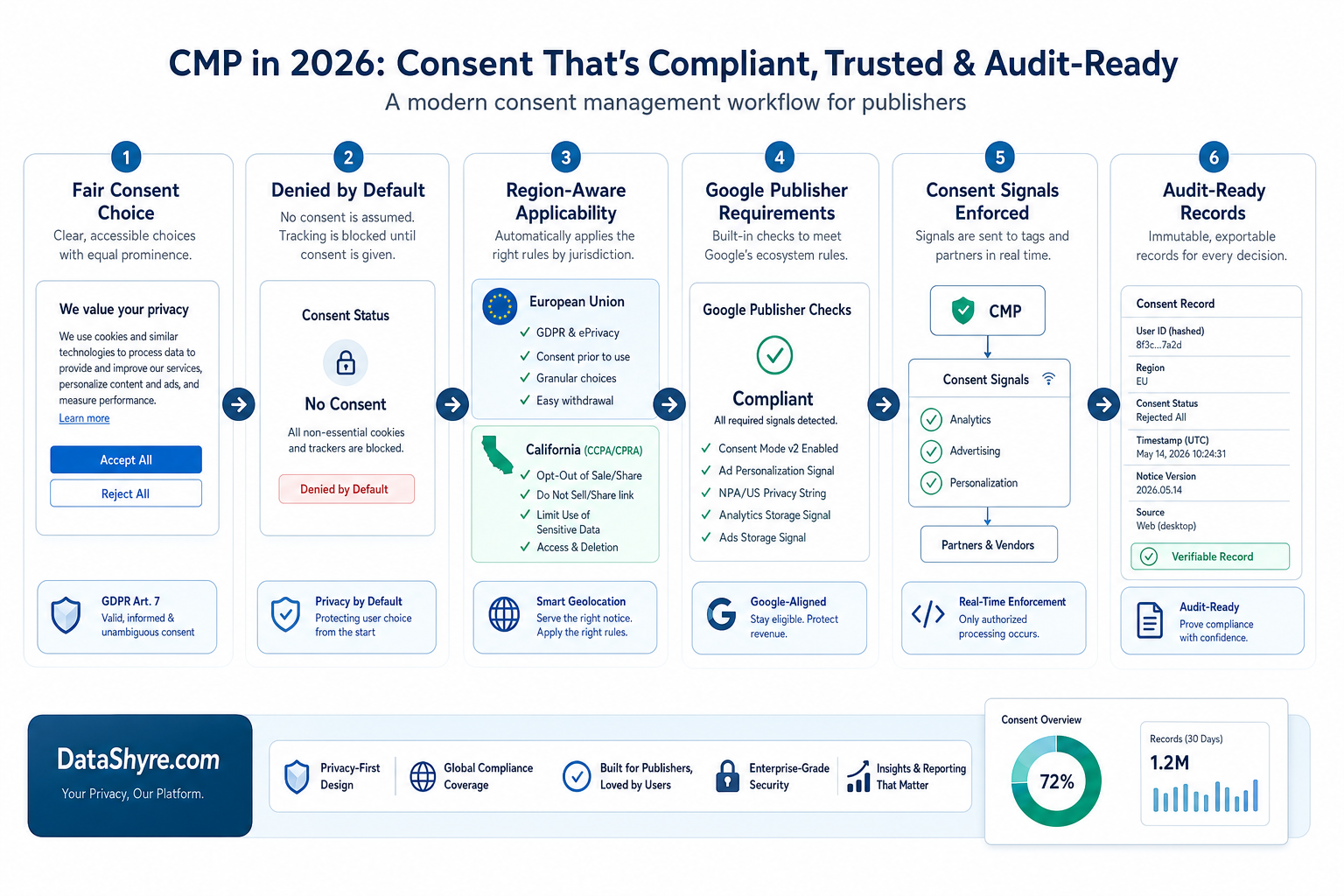
6. Check whether the records explain both the promise and the behavior
The collection moment is only half of the job.
If you are evaluating a consent management platform cmp, the evidence layer should usually let you reconstruct:
- what notice or banner version the user saw;
- which purposes or categories were presented;
- what the user selected and when;
- which regional rule set applied;
- what technical state followed from that selection;
- what happened when the user later changed or withdrew the choice.
This is where many stacks fail the support-and-audit test. They can produce a single yes-or-no record, but not a usable story that explains what the site actually did.
7. Check how the platform handles drift after launch
This is where mature CMPs separate themselves from prettier ones.
Sites change. Marketing adds a vendor. Engineering republishes a tag container. Product embeds a new tool. The ICO’s 2026 storage-and-access-technologies guidance matters here because it reflects a wider tracking surface than older cookie-only reviews.
So a durable consent management platform cmp should help your team detect drift by supporting at least some mix of:
- rescans or change detection;
- uncategorized-script review;
- governance or approval steps;
- records that show when the live site stopped matching the declared model.
Without that, you are not really buying a durable control. You are buying a launch-day screenshot.
A short review sequence for this week
If you were reviewing a consent management platform cmp today, I would work in this order:
- compare
Reject allfriction withAccept all; - run a clean visit and watch what happens before any click;
- trace one reject path and one later withdrawal path;
- test the California branch, including GPC, if it applies;
- test the Google publisher branch separately if ads matter;
- export the records and see whether a non-technical stakeholder could use them;
- decide how the platform exposes drift after future releases.
That sequence usually tells you more than another vendor feature checklist.
Bottom line
The best consent management platform cmp in 2026 is not the one with the nicest banner preview.
It is the one that gives users a fair first choice, applies the right model by region, enforces the choice before optional data use begins, satisfies publisher-specific Google requirements where relevant, and leaves behind proof your team can still trust after the site changes.
Seen clearly, consent management platform cmp is less about a pop-up and more about whether the site behaves honestly after the visitor makes a choice.
Sources
- European Commission: Legal grounds for processing data
- Google for Developers: Set up consent mode on websites
- Google AdSense Help: Google consent management requirements for serving ads in the EEA, the UK and Switzerland (for publishers)
- ICO: Final storage and access technologies guidance published
- ICO: Guidance on the use of storage and access technologies
- CNIL: Dark Patterns in Cookie Banners: CNIL issues formal notice to website publishers
- California Department of Justice: California Consumer Privacy Act (CCPA)
- California Department of Justice: Global Privacy Control
- California Privacy Protection Agency: CCPA Updates, Cybersecurity Audits, Risk Assessments, Automated Decisionmaking Technology, and Insurance Regulations
—
Published: October 15, 2026. Updated using current official regulator, government, and platform materials available at publication time.