
Cookie Policy Generator in 2026: What It Covers, What It Misses, and 7 Live Checks
A useful guide to cookie policy generator should help readers understand both the rule and the behavior behind the rule. That is where consent topics become genuinely practical instead of sounding like recycled compliance copy.
The practical review for cookie policy generator starts when you look past the banner copy and test the live behavior. That is usually where teams find the real gaps: tags firing too early, weak refusal flows, and settings that drift after routine site changes.
That gap matters more than ever right now. The ICO finalized its storage-and-access-technologies guidance on April 29, 2026 and says sites must give users “clear and comprehensive information” about these technologies, including purpose, third parties, and duration. The European Commission still says valid consent must use “clear and plain language” and be as easy to withdraw as to give. California’s Department of Justice says a privacy policy should give a “broad picture” of collection, use, sharing, and sale practices, and the CCPA still ties notices and rights information back to the privacy policy.
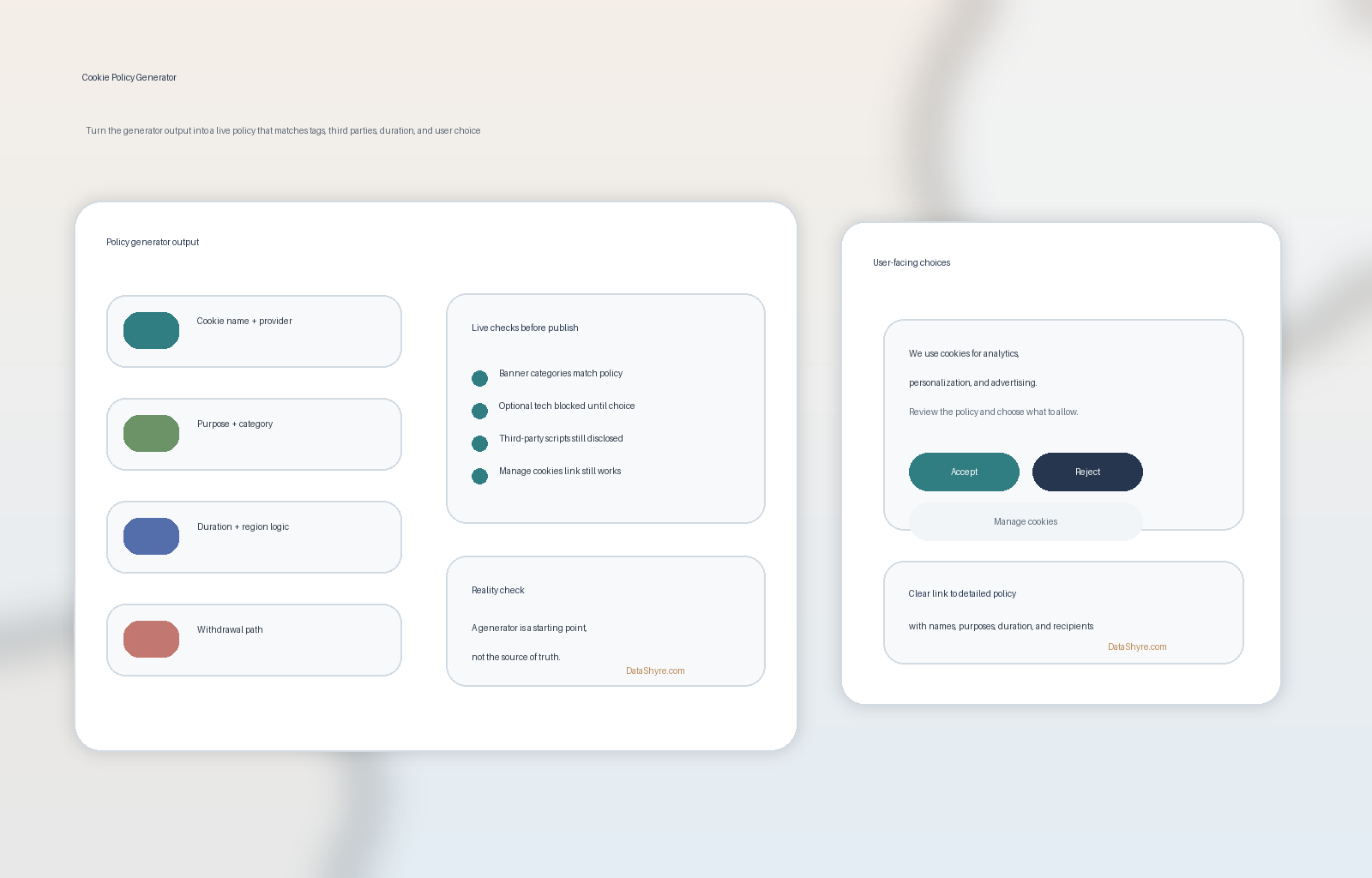
So a strong cookie policy generator is not a magic compliance button.
It is a drafting shortcut that still depends on a real inventory, a real consent flow, and a real update process after the stack changes.
For adjacent context, start with these guides to website cookies, privacy policy template, and what is cookie consent. This page stays narrower. It is the cookie policy generator review I would use this week before publishing one on a real site.
If your team is trying to get cookie policy generator under control without adding a heavyweight privacy stack, DataShyre can help. DataShyre focuses on consent and preference management that are easier to implement, easier to operate, and easier to trust on a live site. Start with DataShyre’s consent and preference management or book a demo.

1. Start with a live inventory, not the generator output
The first cookie policy generator mistake is treating the generated text as the source of truth.
It is not.
The source of truth is the live tracking behavior on the site, app, or embedded service:
- which cookies or similar technologies are in use;
- which provider sets them;
- what each one is for;
- whether it is necessary or optional;
- how long it persists; and
- whether another company receives the resulting data.
The ICO’s current guidance is useful here because it spells out what the disclosure layer still needs to cover: what technologies you plan to use, the purposes, any third parties involved, and how long the technologies store or access information.
That means a cookie policy generator should come after the scan, not before it.
If the site has changed since the last inventory, the generated policy will often look polished while already being wrong.
2. Make the policy answer the questions regulators still care about
A thin cookie policy generator usually produces a generic paragraph like we use cookies to improve your experience.
That is not enough.
The practical 2026 version should help your team publish a page that answers at least these questions clearly:
- what categories of cookies or similar technologies are used;
- which specific purposes those categories support;
- whether first parties or third parties are involved;
- how long the identifiers last;
- how the person can refuse or withdraw; and
- where the person can read the wider privacy notice.
The European Commission’s current guidance on consent still stresses specific purpose, clear language, and an easy withdrawal path. California’s DOJ guidance still expects a privacy policy to tell people what is collected, how it is collected, why it is collected, and where they can find the business’s privacy practices and privacy-rights information.
So a cookie policy generator is only doing real work when it pushes the output past vague category labels and into operational detail.
3. Separate necessary technologies from optional tracking
This is one of the biggest differences between a decent cookie policy generator and a weak one.
The ICO’s current guidance says prior consent is required for non-exempt storage and access technologies unless an exception applies, and it also says the exception for strictly necessary technologies has to be assessed from the user’s point of view, not the publisher’s convenience.
That should change how you review the generated text.
The policy should make it easy to distinguish:
- essential sign-in, security, cart, or load-balancing functions;
- audience measurement that may have a narrow exemption in some setups;
- personalization or preference tools;
- advertising, retargeting, and cross-site measurement tools; and
- embedded services that quietly introduce their own identifiers.
If the generated page lumps all of that into one block, it is already too abstract to trust.
4. Match the policy to the banner, CMP, and withdrawal path
A cookie policy generator does not live on its own page.
It sits inside a wider user-choice system.
That means the generated policy should agree with:
- the first-layer banner copy;
- the category labels in your CMP;
- the default state before a user acts;
- the later
manage cookiesorprivacy settingsroute; and - the actual effect of rejection or withdrawal.
The CNIL’s updated FAQ, published on April 29, 2026, says refusal must be as easy as acceptance and withdrawal must remain simple and available during navigation. The ICO’s current PECR guidance makes the same theme operational by saying users must be able to refuse non-exempt technologies as easily as they can accept them, and that withdrawal must stay easy too.
So if your cookie policy generator says users can change preferences any time, test that claim in the browser.
This is also where many teams discover that the policy page is more honest than the runtime, or the runtime is more detailed than the policy.
Either way, something is drifting.

5. Do not treat the cookie policy as a substitute for the wider privacy policy
Some teams use a cookie policy generator because they are really trying to avoid the harder work of maintaining the broader privacy notice.
That usually backfires.
California’s DOJ says the privacy policy gives a broad picture of collection, use, sharing, and sale practices, and the CCPA says the notice at collection should link back to that policy for fuller detail. In real deployments, the cookie page and the privacy policy need to support each other:
- the cookie page explains technologies, categories, providers, duration, and controls;
- the privacy policy explains the wider collection, use, sharing, retention, rights, and contact structure;
- both need to agree on third parties, purposes, and user choices.
A cookie policy generator is therefore a component, not the whole disclosure system.
If the generated page is the only place your site explains tracking, the surrounding policy layer is probably too thin.
6. Bring third-party embeds, plugins, and app SDKs into scope
Another frequent cookie policy generator failure is assuming the page only needs to describe classic website cookies.
The 2026 regulator guidance is wider than that.
The ICO’s April 2026 storage-and-access-technologies guidance explicitly covers tracking pixels, device fingerprinting, scripts, and similar technologies, not only browser cookies. The same guidance also says you remain responsible for technologies you incorporate from other organizations.
So when using a cookie policy generator, check whether it accounts for:
- analytics tags and tag-manager deployments;
- video, chat, or social embeds;
- CAPTCHA providers;
- affiliate or ad-tech scripts;
- mobile-app SDKs; and
- any cross-domain or multi-brand consent behavior.
If the generator only knows what a scanner found on one page load, it may miss the extra branches that matter most.
7. Add an update trigger before the next release breaks the policy
The best cookie policy generator output is still only a snapshot.
This is why the update process matters as much as the first draft.
The ICO says users should be told about these technologies in a transparent way and that organizations should understand ongoing third-party and duration implications. The California DOJ says the privacy policy should be updated at least once a year. In real deployments, a strong site should update much sooner whenever the tracking picture materially changes.
Your cookie policy generator workflow should therefore trigger a review when:
- a new plugin, pixel, or SDK is added;
- a tag-manager container changes;
- a vendor starts receiving data for a new purpose;
- a banner category or consent logic changes;
- a new region or property goes live; or
- the user-facing manage-preferences route changes.
If that review does not happen, the generator becomes a stale copy machine instead of a useful control.
A practical review order for this week
If you were reviewing a cookie policy generator today, use this order:
- scan the live stack and build the actual inventory;
- confirm necessary versus optional categorization;
- add provider, purpose, duration, and third-party details;
- compare the policy against the banner and withdrawal path;
- sync the page with the broader privacy policy and regional rights language; and
- set a re-review trigger for the next plugin, tag, vendor, or consent change.
That order usually catches the real problems faster than polishing the wording first.
FAQ
Is a cookie policy generator enough by itself?
No. A cookie policy generator can speed up drafting, but it cannot confirm whether the live site really blocks optional technologies before consent, whether third parties still match the disclosure, or whether the withdrawal path still works.
Do I need both a cookie policy and a privacy policy?
Usually yes. The cookie page should explain tracking technologies and controls in more detail, while the privacy policy covers the broader collection, use, sharing, retention, and rights picture.
What is the biggest risk with a cookie policy generator?
Operational drift. The text gets generated once, then the tag manager, embeds, plugins, or consent setup changes while the page stays frozen.
Bottom line
The best cookie policy generator in 2026 is not the one with the longest template library.
It is the one your team treats as a drafting layer on top of a real inventory, a real consent flow, and a real update process.
Seen clearly, cookie policy generator is less about a pop-up and more about whether the site behaves honestly after the visitor makes a choice.
Sources
- ICO, What are the PECR rules?: https://ico.org.uk/for-organisations/direct-marketing-and-privacy-and-electronic-communications/guidance-on-the-use-of-storage-and-access-technologies/what-are-the-pecr-rules
- ICO, Final storage and access technologies guidance published (April 29, 2026): https://ico.org.uk/about-the-ico/media-centre/news-and-blogs/2026/04/final-storage-and-access-technologies-guidance-published/
- European Commission, Legal grounds for processing data: https://commission.europa.eu/law/law-topic/data-protection/information-business-and-organisations/legal-grounds-processing-data_en
- California Department of Justice, How to Read a Privacy Policy: https://oag.ca.gov/node/36676
- California Department of Justice, California Consumer Privacy Act (CCPA): https://www.oag.ca.gov/privacy/ccpa
- CNIL, Questions-réponses sur les lignes directrices modificatives et la recommandation « cookies et autres traceurs »: https://cnil.fr/fr/cookies-et-autres-traceurs/regles/cookies/FAQ